Description
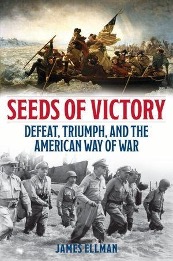
Seeds of Victory: Defeat & Triumph by James Ellman
Prestonwood CC, 15909 Preston Road, Dallas, TX. Please arrive by 7:15 a.m. to order from the
menu. Breakfast is $20. Discussion starts at 7:30 and ends at 9:00.
RSVP to Bob Epstein at: macabee1948@gmail.com
The discussion will be guided by John Caldwell: CPA, 9 Marathons (PB 3:15) and Robert Epstein:
Texas Guard- Military Police Brigade; 20 years law enforcement
Like all armed forces, the United States military–often
celebrated for its victories–has been defeated on the battlefield
throughout its long history. Unlike some others, the United
States has shown a remarkable ability to bounce back from
defeat: to learn from the loss, recover, and turn it into victory. In
this book James Ellman, who has established a reputation for
his reconsiderations of military history, takes a close look at nine
such pivot points on the ground, in the air, and at sea, from the
American Revolution through the Korean War:
Long Island (1776) to Saratoga (1777)
Invasion of Canada (1812) to Battle of Lake Erie (1813)
First Bull Run (1861) to Antietam (1862)
Pearl Harbor (1941) to Midway (1942)
Luzon (1942) to Buna-Gona (1943)
Schweinfurt/Ploesti (1943) to "Big Week" (1944)
Chongchon (1950) to Operation Ripper (1951)
In brisk narratives, Ellman describes each battle, explaining how it
was fought and lost, and then shifts gears to detail how leaders–
military as well as civilian–such as George Washington, Abraham Lincoln, Douglas MacArthur, Dwight
Eisenhower, and George Patton assessed the factors that led to defeat, made changes to training,
tactics, and strategy, and entered the next battle wiser and better prepared. Ellman finally recounts the
subsequent battle, focusing on how it was shaped by what came before and how the victory was
gained.
As this book makes clear, the history of the United States at war is, to a surprising degree, the story of
tenacity in the wake of defeat, of flexibility and adaptability on the path to victory. This is essential
reading for understanding how battles are lost and won.